
Essential Painting Tools and Techniques for Smooth, Even Walls
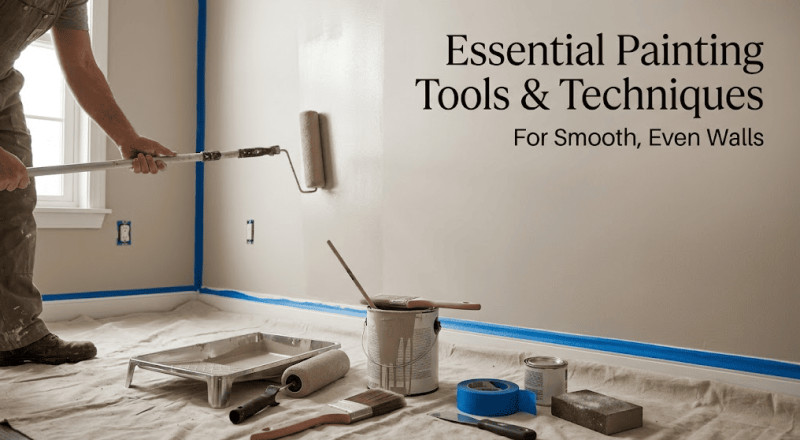
You do not need an enormous collection of equipment to paint a room well. A few suitable tools, a properly prepared wall, and a consistent technique make a much bigger difference than expensive accessories. This guide covers the practical essentials for applying smooth, even coats to interior walls.
Build a basic painting kit
- Angled brush: useful for precise edges around corners, frames, and trim.
- Roller frame and sleeves: choose the sleeve material and pile length for the coating and wall texture.
- Roller tray or bucket grid: helps load paint without over-saturating the sleeve.
- Extension pole: supports comfortable, consistent rolling on larger walls.
- Filler knife and suitable abrasive: for repair work before painting.
- Drop cloths and low-tack masking tape: for protecting floors and finished surfaces.
- Stirrer, clean cloths, and work light: useful for mixing, cleanup, and inspection.
Buy the brush and roller recommended by the coating manufacturer. A very short roller pile may struggle on a textured wall, while an overly long pile can leave an unwanted texture on a very smooth one.
Set up the work area
Cover the floor and move furniture away from the painting zone. Stir the paint as instructed and pour only the amount you need into a clean tray. Work with suitable ventilation and lighting. Keep ladders on stable, level ground; use an extension pole when practical instead of stretching from the top of a ladder.
Cut in around edges
Cutting in means painting the narrow areas that a roller cannot reach neatly, such as ceiling lines and inside corners. Load only part of the brush, remove excess paint, and guide it with a steady hand. Work in manageable sections so the brushed edges can blend with the rolled area before they dry, where the product allows.
Masking tape can help protect surfaces, but it is not a replacement for careful brush control. Apply tape only to clean, suitable surfaces, and remove it according to its instructions to reduce the risk of lifting the fresh coating.
Use the roller with a wet edge
- Load the sleeve evenly and roll off excess paint on the tray or grid.
- Start in an upper section and distribute paint over a manageable area.
- Roll in overlapping passes without pressing excessively.
- Finish each section with light, consistent strokes if recommended for the product.
- Continue into the adjacent area while the edge is still wet.
Keeping a wet edge helps limit visible overlaps called lap marks. Do not repeatedly roll a surface that has already begun to set; this can disturb the developing finish. Follow the product's instructions for spread rate and application method.
Use multiple coats correctly
Two finish coats are often used on interior walls, but the actual requirement depends on the product, color change, and substrate. Do not apply the next coat merely because the wall feels dry to the touch. Respect the manufacturer's recoat time, which may differ from its surface-dry time. Maintain the recommended temperature and ventilation.
Prevent common mistakes
- Patchy coverage: check surface porosity, primer choice, and paint loading.
- Roller lines: avoid heavy pressure and keep a consistent rolling method.
- Drips: remove excess paint from brushes and rollers before reaching edges.
- Rough texture: keep tools and the surface clean and avoid overworking the coating.
- Peeling: investigate preparation, moisture, and product compatibility rather than adding another coat.
Clean up and inspect
Clean tools using the method given on the paint label and dispose of wash water or solvents responsibly. When the wall is fully dry, inspect it under natural and artificial light. A calm, even finish is the result of steady technique and patience, not speed.
Your Comment